Industry Session at the IGA Biennial General Meeting
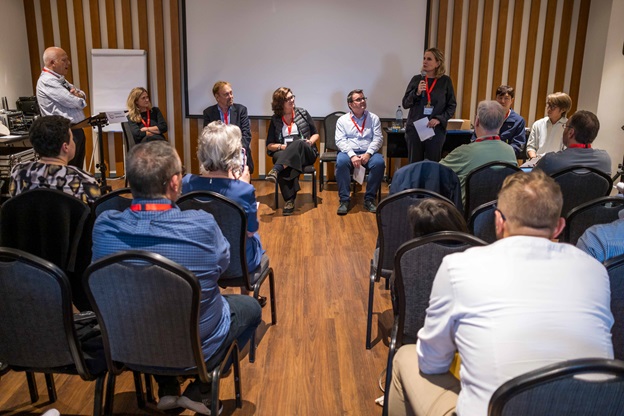
The final session of the International Gaucher Alliance’s Biennial General Meeting last month was an opportunity for IGA members and invited representatives of the pharmaceutical industry to look at ways forward for further collaboration.
Industry representatives were:
· Jim Howley, Global Lead for Patient Advocacy and Engagement for Prevail, part of Eli Lilly
· Cristina Cardoso, Global Public Affairs Head for Rare Nephrology and Rare Ethology at Sanofi
· Simon Flynn, Director of Medical Sciences at Spur Therapeutics
· Gisela Linthorst, Head of Patient Engagement at Azafaros
· Mr Choi representing ISU Abxis from South Korea.
In a twist to the usual process, each Pharma rep asked the members two questions (rather than the panel being questioned). This provided a good opportunity for representatives of industry to hear from patient representatives about their views and challenges.
Q. 1 For patients who have been receiving treatment for a few years now, has treatment delivered what you hoped it would, or are there aspects that still need to be worked on?
Q.2 Can you share which symptoms have shown the least improvement despite constant treatment?
People spoke of bone pain, fatigue and taking longer to recover from an illness. It was also mentioned that there is still no treatment for the neurological symptoms of Type 3 Gaucher disease.
Q.3 When talking about Gaucher Type 3, what are the most relevant and impactful neurological symptoms to consider, and what would be, in your opinion, an important improvement?
Q.4 What are your current and main needs of GD3 patients, and what are your key challenges and opportunities regarding diagnosis, access to care, and disease monitoring?
People mentioned abnormal eye movement, seizures and tremors. The main unmet need is that there is no specific treatment for GD3. One GD3 patient talked about defining what an outcome is, and defining what success of treatment looks like. For many families with GD3, just improving the quality of life, being able to eat their own food or ambulate or use the toilet, these are all successful outcomes. Patients are looking for treatments and technologies to improve quality of life at the same time as looking for a cure. The psychological impact of GD3 needs to be studied, and there is more work to be done around the world educating specialists about GD3, as often GD3 patients are being looked after by specialists who are more experienced than GD1,
Q.5 Are there concerns about accessing your current medication if you participate in the trial and need to return to your previous treatments if you were to go on a clinical trial?
There were differing views on this question, particularly relating to the political stability of the country involved.
Q.6 Do you plan to continue ERT treatment in the future? If anyone is considering discontinuing ERT, could you provide insight into the reasons for this decision?
Some people felt that ERT was working well for them for now, but they might consider switching to SRT in the future, for example if inserting the needle for the infusion became difficult. Others said that patients are often counting the days until they can switch to an oral treatment, although the older generation often favours ERT. However, there is often disappointment when switching does not work because of side effects. One patient who switched 10 months ago after 26 years on ERT (using home-infusion) said that even though ERT was relatively straightforward for her, her life has been improved massively by switching to SRT. The issue of having to travel long distances every fortnight to receive treatment in some parts of the world was raised. Even access to any treatment in some of these countries can be an issue.
Q.7 When as a patient community, you work with a drug development company, what are the three crucial factors the company should take into consideration?
People mentioned an honest relationship and being really willing to know patients’ contexts. Patients know what is happening in the field. There needs to be transparency, humility and an open mind to the patients and their messages. Programmes need to be developed not only for patients but for those who take care of them. Companies need to have a good understanding of the patient community even before coming into this space. There can be miscommunication which can lead to disappointment both from the patient side and from the company side. Patients and carers want you to be their partners forever because the patient community is committed to this relationship. It’s important to engage with the patient community in the design of the trial, the choosing of the endpoints, the setting and to take it all the way through.
Q.8 For those of you that might consider taking part in a clinical trial now or in the future, I’m interested to understand what are the factors that would influence your decision whether to take part or not?
Q.9 Would you consider travelling internationally to participate in a trial? What are your hopes and fears regarding this?
For people in many countries, visas can be an issue. There is a need to reduce the burden on patients participating in a clinical trial. One patient currently on a trial said she has nearly dropped out a couple of times because it seems that the trial is not being run to suit the patient. It can be very lonely and a constant battle. Another patient said she would love to go an a clinical trial, even if it meant travelling internationally, if it was better than what she had now. One patient described travelling 2000 miles every two weeks for to participate in a clinical trial.
Q.10 If you were in our shoes, what would be your plan of action towards the Gaucher community for the next three years and what do you think success looks like?
Educating doctors to treat patients holistically and to give some education about mental health, about tools, how to live with the worries connected to rare disease and chronic disease, about self-management. On person said that in three years there should be no patients without treatment. It was noted that the purchasing power in countries in many parts of the world is not the same as in North America, so maybe the pricing can be decided based on that. The major problem is that the world is unfair, and pharma companies can help to solve this. It’s not enough to give free treatment to patients because in many of these countries, even patients on Charitable Access programmes cannot get to the hospital. They don’t have the funds to actually even travel to the hospital to get the free treatment. It needs to be more of a holistic package working together with the patient community or the clinicians in terms of access to actual treatment.
Summing up, IGA Honorary President Jeremy Manuel said that the conversation was “an indication of the relationships that we as an international organisation have with you as international companies. And it was one of, I trust, mutual respect. And, you know, we may be robust from time to time, but that’s not to mean that we are opposing each other. We’re trying to work to a similar or the same solution that’s coming from different channels.”