

Types & Symptoms of Gaucher Disease

Three types. Different experiences. A shared community.

What are the Different Types of Gaucher Disease?

There are three types of Gaucher disease: type 1, type 2 and type 3.

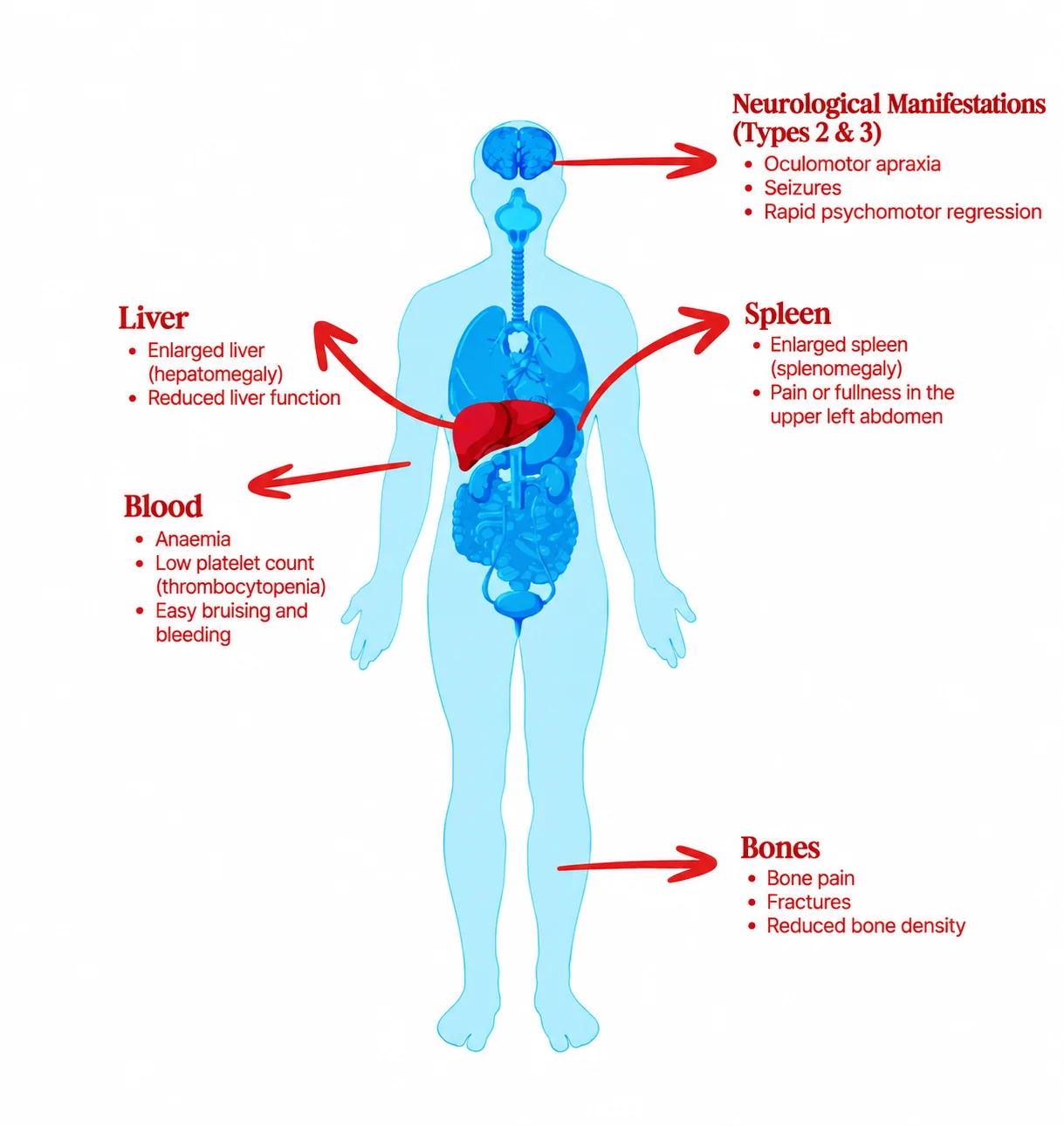
They share some features, including possible effects on the spleen, liver, blood and bones, but differ in whether and how the brain and nervous system are affected.

Type 1

The most common form

Usually does not affect the nervous system. Symptoms can range from very mild to severe.

Type 2

A very rare, rapidly progressive form
Affects the brain and nervous system and usually begins during infancy.

Type 3

A chronic form with neurological involvement
Affects the brain and nervous system and generally progresses more slowly than type 2.

Type 1 Gaucher disease

The most common form
Type 1 Gaucher disease accounts for around 90% of cases in people with Gaucher disease. It can be diagnosed at any age and the signs and symptoms vary greatly among people. Type 1 is sometimes called non-neuronopathic Gaucher disease because it does not generally affect the brain and nervous system.

Common features may include:

Type 1 Gaucher disease and other health conditions

Research has identified associations between GBA1 variants and Parkinson's disease, and people with Gaucher disease type 1 have been reported to have an increased risk of Parkinson's disease compared with the general population. However, the risk is age-dependent and only a minority of people with Gaucher disease develop Parkinson's disease. Current research continues to investigate the biological mechanisms underlying this association.
People with Gaucher disease also have an increased risk of multiple myeloma, although the reasons for this association are not fully understood.

Type 2 Gaucher disease

A rare, rapidly progressive form
Type 2 Gaucher disease is a very rare form of Gaucher disease. It affects the brain and nervous system, as well as the spleen, liver, lungs and bones. Symptoms usually appear during infancy, sometimes between 1 and 4 months of age, and the disease progresses rapidly. Type 2 is also called acute neuronopathic Gaucher disease or acute infantile neuronopathic Gaucher disease.

Symptoms may include:

Type 3 Gaucher disease

A chronic form with neurological involvement
Type 3 Gaucher disease affects the brain and nervous system, as well as the spleen, liver, blood and bones. It generally begins during childhood or adolescence and progresses more slowly than type 2, although the severe form can cause very severe symptoms and significantly affect individuals.

Symptoms may include:

Symptoms can vary greatly

Gaucher disease does not affect everyone in the same way. The age at which symptoms appear, organs affected, severity and rate of progression can vary considerably, even among people with the same type of Gaucher disease. Some people may have few symptoms, while others require ongoing specialist care for multiple complications. Understanding the type and individual features of Gaucher disease can help healthcare professionals plan appropriate monitoring and care.

Explore more about Gaucher disease

About Gaucher

Related Resources

You’re Not Alone

Whether you are living with Gaucher disease, caring for someone, or looking for information, this community is here to support you.